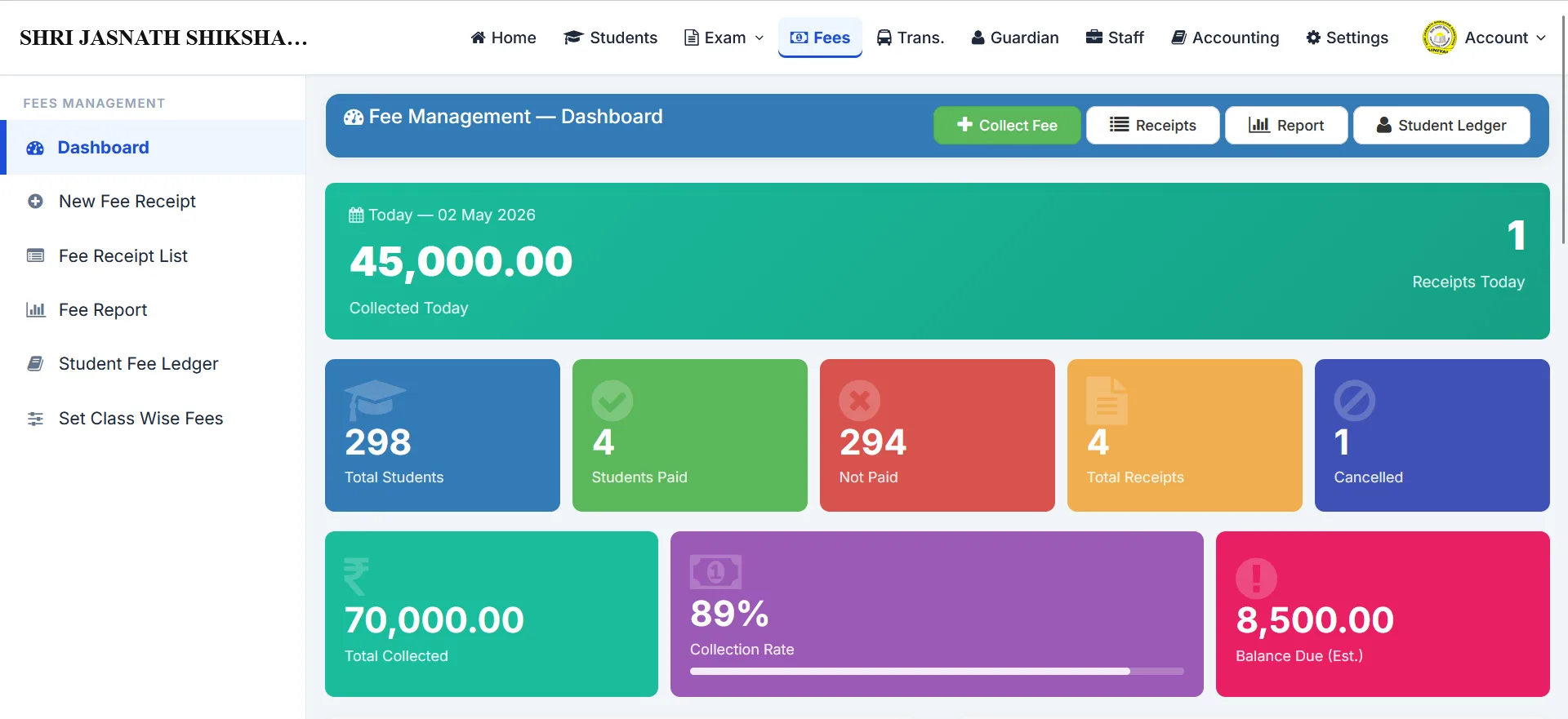
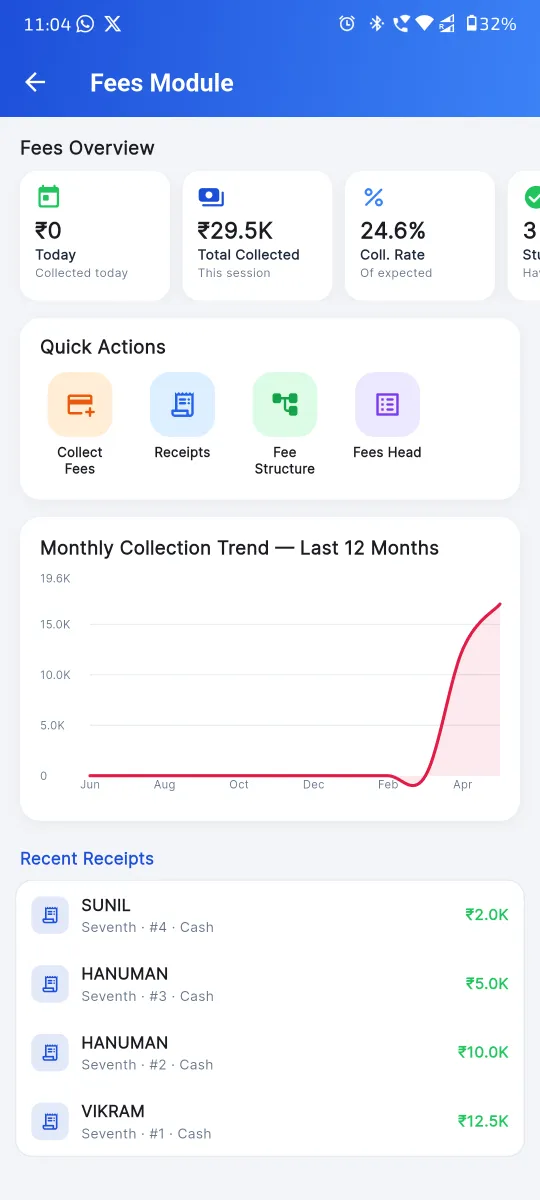
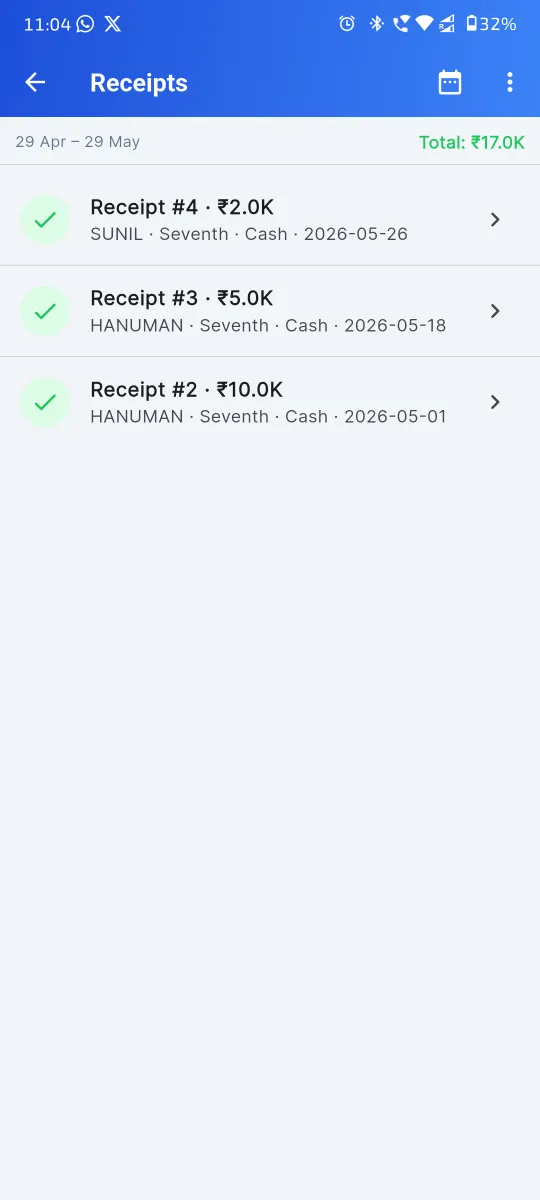
Everything in the Fee Module
Indian-school specifics — multi-head structure, per-day late fee, thermal receipts, audit trail.
Multi-Head Fee Structure
Tuition, Transport, Lab, Annual etc. — per class, per session. Each head a separate line on the receipt.
Class- & Session-Wise Amounts
Class 5 Tuition for 2025–26 = ₹6,500 is one row. 2026–27 amounts sit alongside without overwriting.
Auto-Applied Late Fee
Per-day late fee on each fee structure. Once due-date passes, late fee is computed automatically.
Cash / Cheque / DD / Online
Each receipt records mode, optional cheque/DD reference, plus discount and fine fields with full audit trail.
Thermal Printer Receipts
Print on the school’s existing 58 mm or 80 mm thermal printer; A4 print also supported.
Edit / Cancel With Reason
Receipts are never silently overwritten. Both edits and cancellations log a reason for audit.
Auto Cash-Book Posting
Every receipt posts under Cash in Hand or Bank. End-of-day reconciliation in 2 minutes.
Free Fee-Reminder Messages
Every plan ships a free WhatsApp + SMS bundle for fee reminders to guardian numbers.
Why fee management is the #1 ROI move
For most Indian schools, the single biggest day-to-day operational cost isn’t teaching — it’s fee management. Three accountants, three receipt books, month-end reconciliation that stretches into a week. Going digital usually increases collection because every receipt has a single counter, every cancellation needs a reason, and every discount sits on the receipt itself.
Read the Setup Guide
Day-1 Fee Setup — in an Afternoon
Configure once. Collect for the rest of the academic year.
Define Fee Heads
Tuition, Transport, Lab, Annual… the labels you actually use on the receipt.
Set Class × Session Amount
Per class, per session. Multi-session preserves last year’s amounts.
Due Date + Late Fee
Set the date and per-day late fee. The system auto-applies it.
Print & Reconcile
Receipts print on thermal or A4; auto-post to the cash book.
School Fee Management FAQ
Yes — thermal-printer fee receipts are a first-class feature. Each school configures its receipt print width to either 58 mm (the smaller, faster, lower-cost roll most counter printers use) or 80 mm (wider receipts with more line items and a clearer breakup). A4 print is also supported for schools that want a single full-page format. The receipt template auto-includes the school name, UDISE / affiliation number, school logo, receipt number, date, student name + class + admission number, fee head breakup (Tuition / Transport / Exam / Other), payment mode, amount in figures and words, and the operator signature space — everything an Indian school accountant needs for compliance and audit.
All four payment modes Indian schools actually use are supported: Cash (most common, posts to the Cash account in the cash book), Cheque (with cheque number, bank name and date captured for reconciliation), DD / Demand Draft (DD number, bank, date), and Online / UPI / Bank Transfer (recorded after the parent has paid via UPI to the school’s configured UPI ID, bank transfer or QR-based collection). Every receipt automatically posts an entry into the accounting cash book against the right own-account (Cash / Bank) and the student’s party-account, so end-of-day reconciliation is one query, not a four-hour Excel exercise. Read more in our UPI school fee payment guide.
Yes — auto-computed late fee is built into every fee structure. For each fee head you set a due date and a per-day late fee; once the due date is crossed, the system auto-adds the late-fee amount based on the days delayed at the moment the parent pays. Cap rules (e.g. “late fee maxes out at ₹500”) and grace periods (e.g. “no late fee in the first 5 days after due date”) can be configured per fee structure. The accountant doesn’t calculate late fees by hand; the receipt prints the late fee as a separate line item; and parents who ask “why am I being charged late fee?” can be shown the exact rule.
Yes — with a written reason, full audit logging, and accountability. Both edits (e.g. payment mode was wrongly entered as Cash but the parent actually paid by Cheque) and cancellations (e.g. parent withdrew the amount, refund issued) are tracked with the operator’s name, timestamp, before-state, after-state and the reason. Cancellations also auto-reverse the cash book entry, so accounting stays in sync. Receipts are never silently overwritten. This audit trail is essential for school inspections, parent disputes, and end-of-year accountant reconciliation. Per-employee role permissions can additionally restrict who is allowed to edit / cancel a receipt at all.
Yes — UPI fee collection is integrated. The school configures its own UPI ID / VPA (e.g. school@hdfcbank); parents pay from any UPI app (PhonePe, Google Pay, Paytm, BHIM, bank UPI app) by scanning the school QR or paying to the VPA. Once the parent has paid, the office records the receipt against the student with payment mode = Online and the UPI reference / UTR. The receipt prints, the cash book auto-posts, and the parent gets a WhatsApp / SMS confirmation. Crucially, there is no per-transaction payment-gateway fee — the school keeps 100% of the fee. For more on this collection model, see UPI school fee payment in India.
Yes — fee concessions and sibling discounts are supported at the per-student level. Concessions can be a flat amount (₹X off Tuition) or a percentage (10% off Annual fee), applied to a specific fee head or to the total. Common Indian-school cases all work: sibling discount (auto-detected via the guardian directory), staff-children discount, RTE-quota fee waiver, scholarship-based concessions, single-parent / orphan concessions. The concession is reflected on the receipt as a clear deduction line, the original fee structure stays untouched, and audit logs show who approved which concession. Reports can list all concessions granted in a session for management review.
Yes — WhatsApp fee reminders are one of the highest-ROI features for Indian schools. Filter outstanding fees by class, section, fee head or due-date range; pick a template (polite reminder, second reminder, urgent reminder); broadcast to the parent WhatsApp numbers from the dashboard. The message can include the student name, due amount, due date, school UPI QR / VPA for instant payment, and a link to the school office. Most schools recover 30–50% of pending dues within 48 hours of a WhatsApp reminder broadcast — far better than printed letters or phone calls. The free WhatsApp / SMS bundle on each plan covers most schools’ reminder volume. Read our complete fee management guide.
Every report an Indian school accountant or principal needs — built in, exportable to PDF and Excel: daily collection report (today’s receipts by mode), defaulter list (all students with pending fees, filterable by class / section / fee head), fee-head-wise collection (Tuition vs Transport vs Exam vs Other), class-wise collection, operator-wise collection (which clerk collected how much — useful for shift handover and accountability), per-student fee statement (entire payment history of one student across the session, ideal for parent-facing print), session-end summary, and cash book integration showing how every fee receipt flows into the school’s books. All reports respect role permissions, so a fee clerk can’t pull reports for classes outside their scope.
Stop Hand-Writing Receipts
See the fee module on a 30-minute live walkthrough — thermal printer included.