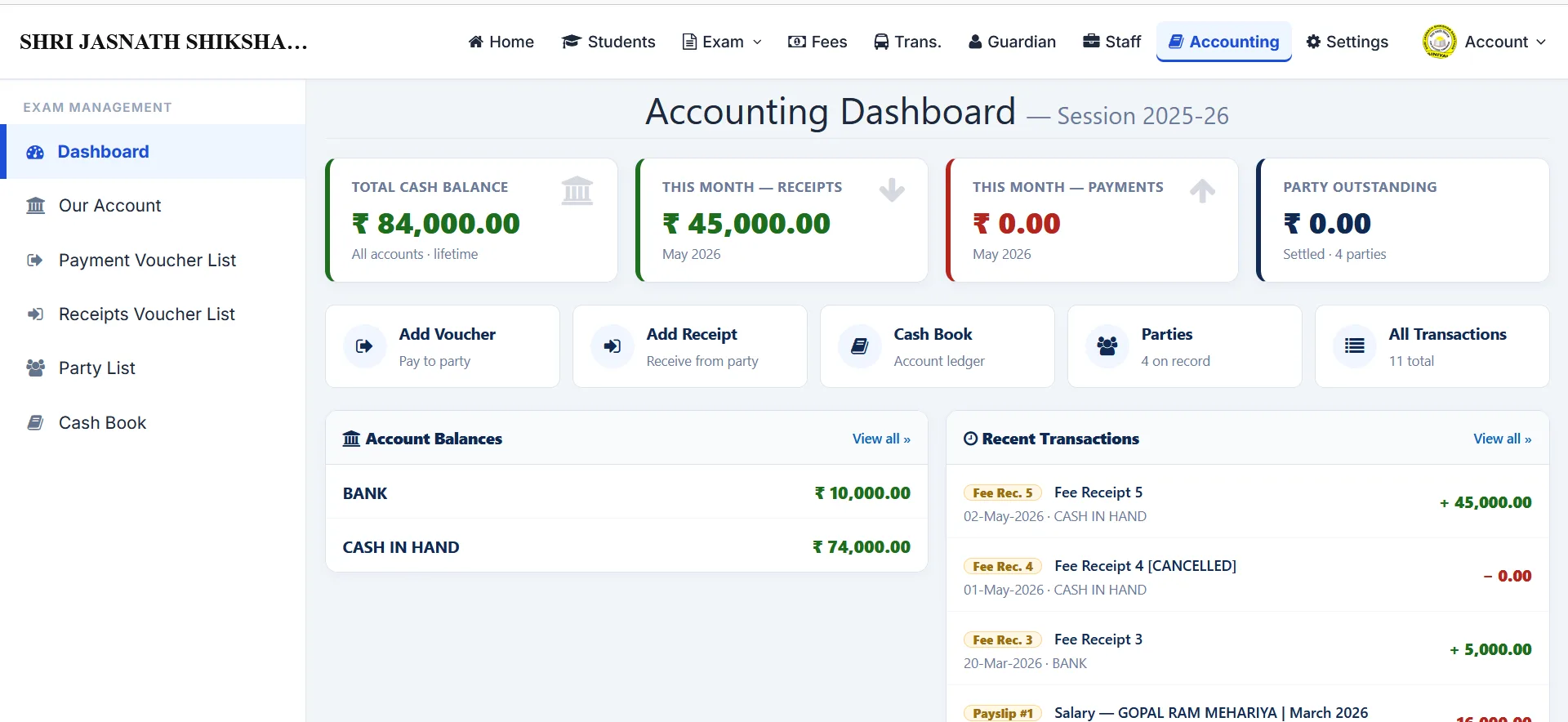
Built for the School Accountant
Not Tally. Not a generic ERP accounting plugin. Just the eight things an Indian school accountant actually does — in one place.
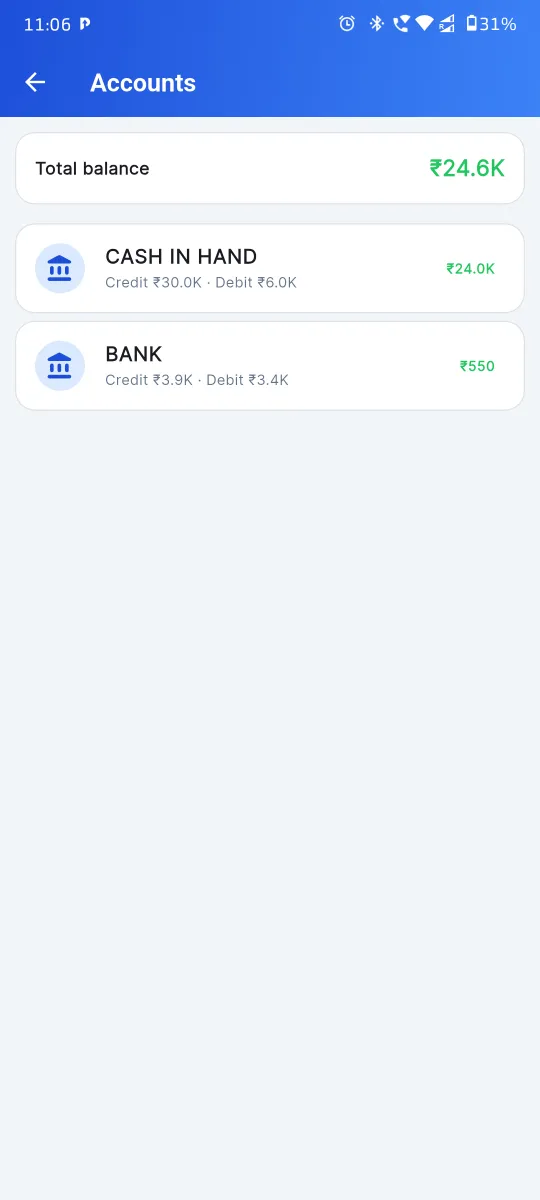
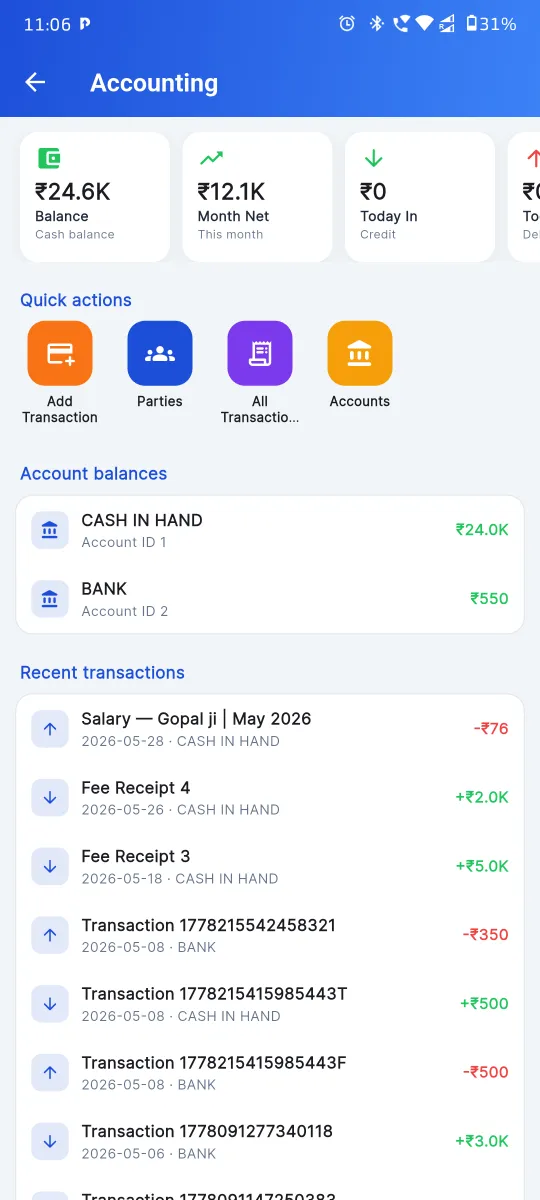
Own Accounts (Cash & Bank)
Cash-in-Hand and Bank as first-class own-accounts. Every receipt and payment posts to one of these.
Party / Vendor Accounts
Maintain separate accounts for vendors (electricity board, stationery supplier, transport contractor, photographer…) with running balance.
Voucher Entries
Two-side voucher entries for any non-fee, non-payslip cash flow — rent, electricity, repair, inward stationery, donations.
Auto-Posted Fee Receipts
Every fee receipt auto-creates a cash-book entry against Cash or Bank, with the student as the party. No double entry.
Auto-Posted Payslips
Every monthly staff payslip auto-creates a cash-book entry — gross, deductions, net — against the right own-account.
Cash Book & Statements
Consolidated cash book, per-account statement, per-party transaction history — all printable, all exportable.
Role-Based Access
Only the accountant and admin see the cash book. Per-module add / edit / view permissions enforce separation of duties.
Transport Revenue Reports
Route-wise transport revenue summary feeds straight into the school’s books, no separate Excel.
Why “no monthly subscription” matters for a school
School cash flow is seasonal. A primary or secondary school in India collects 70–80% of its yearly revenue in two windows — April–June (annual / Q1 fees) and October–November (Q3 / mid-year fees). The summer-vacation months (May, June) and the long winter break (December, January) are tight on cash. A monthly-billed software that charges ₹1,500 / month becomes a recurring drag during those tight months. Apna School is deliberately a single yearly ₹4,999 subscription — one payment, one PO, one approval, one tax invoice. The school accountant doesn’t deal with twelve invoices, no auto-debit failures, no pro-rata mid-month confusion. Every Apna School module — including this accounting module — is included in the same flat ₹4,999 yearly subscription. Read about the model in our affordable school ERP guide.
Book Free Demo
Day-End Accounting in 2 Minutes
Cash & Bank Auto-Update
Every fee receipt has already auto-posted under Cash or Bank during the day. No re-entry.
Add Today’s Vouchers
Type in the day’s few non-fee outflows — electricity, stationery, repair — against vendor accounts.
Match Cash on Hand
System cash balance vs physical drawer. End-of-day cash count tallies in one screen.
Print Cash Book
Hand the printed cash book to the principal. Done. No Tally, no Excel, no second software.
Yearly — No Monthly Trap
School Accounting Software FAQ
For most Indian K-12 schools — yes. The Apna School accounting module covers everything a typical primary or secondary school needs: own accounts (Cash, Bank), party / vendor accounts (electricity board, stationery supplier, transport contractor, photographer), voucher entries, the consolidated cash book, per-account and per-party transaction statements, auto-posted fee receipts, auto-posted staff payslips, route-wise transport revenue. The two big advantages over Tally: (1) fee receipts and payslips post automatically into accounting — no double-entry, no monthly “import last month’s data into Tally” ritual, and (2) per-employee role permissions so the fee clerk only sees fees, not the entire school’s accounts. For schools that have a separate audit firm using Tally, the Apna School cash book and party statement export to Excel and feeds directly into Tally as a journal voucher batch. Read more in school fee management tips.
No — deliberately. Apna School is a yearly subscription only, ₹4,999 / year flat. School cash flow is highly seasonal (heavy collection in April–June and October–November, tight in May–June and December–January), and a monthly-billed software becomes a recurring drag during the tight months. A single yearly invoice means: one PO, one approval, one tax invoice, no auto-debit failures, no pro-rata mid-month surprises. Some competitor school ERPs lure schools with ₹999 / month pricing that compounds to ₹12,000 / year — more than 2.4× the Apna School yearly price. The flat-yearly model is one of the things our schools tell us they value most. See the pricing page.
Per-vendor party account with running balance, transaction history and search. Common Indian-school vendor patterns all work: electricity board (one account, monthly bill, payment voucher every 30 days), stationery supplier (purchase voucher when stock arrives, payment voucher when paid — balance shows what’s outstanding), transport contractor (monthly bill, fuel reimbursement, payment voucher), photographer (one-time engagement, advance + balance), repair contractor (per-job vouchers), donor / scholarship sponsor (donation receipts as own-account credits). Each party has its own statement — printable for tax filing, vendor reconciliation or audit defense. The party master is per-school (not shared across schools) for full tenant isolation.
Yes — auto-posting is the single biggest reason schools move from Tally + Excel to Apna School. When the fee clerk records a fee receipt for a student (Cash ₹5,000), the cash book auto-creates an entry under Cash in Hand with the student as the party and the fee head break-up as the narration. When the school accountant generates monthly payslips for staff, every payslip auto-creates a payment voucher: gross, deductions, net — debit Salaries (own-account), credit Cash or Bank. The accountant doesn’t re-enter anything. End-of-day cash position, end-of-month payroll posting, and end-of-year financial summary all come from the same single source of truth. Audit logging records who created the original receipt / payslip, when, and any later edit / cancel.
Yes — Excel and PDF export on every accounting screen. The cash book exports in standard two-side format (Date, Particulars, Debit, Credit, Balance). Per-party statement exports with opening balance, every transaction, closing balance — same format the auditor expects. Per-account statement does the same for own-accounts (Cash, Bank). For schools whose audit firm uses Tally, the export can be reformatted into a Tally journal voucher batch. For schools whose audit firm uses standard Excel-based working papers, the native export is ready to use. The accountant can also print physical books — cash book sheets in landscape A4, ready to be filed. End-of-year audit prep that used to take a fortnight is now a half-day.
Yes — in fact, very small schools (50–100 students) get the biggest ROI from this module. A school of 100 students typically has the principal/owner doing accounts in the evening, on a notebook, with one helper. Tally is overkill (₹18,000+ for the perpetual licence, plus Tally training cost), and a CA-grade accounting software is wasted. Apna School’s built-in cash book + party accounts + voucher engine gives the principal exactly what they need: a tally of today’s collection, a list of pending fee defaulters, the salary outflow of staff, the electricity / stationery / transport vendor balance, and a printable cash book at year-end — all included in the ₹4,999 / year Apna School subscription. Read about why low-cost ERPs win in Tier-2/3 cities in our affordable school ERP guide.
Yes — UPI fee collection auto-posts under Bank. When the fee clerk records a fee receipt with payment mode = Online (UPI), the receipt captures the UPI transaction reference / UTR, and the cash book auto-creates an entry under the Bank own-account (instead of Cash). End-of-day, the school’s bank statement is reconciled against the day’s UPI receipts in two minutes — one query lists every UPI receipt with its UTR. Since Apna School uses the school’s own UPI VPA / QR (not a payment-gateway aggregator), there is no per-transaction PG fee — the school keeps 100% of the fee. See UPI school fee management for a deep-dive.
Forever, as long as the school’s subscription is active. Apna School is multi-academic-session by design — cash book entries from 2024–25, 2025–26, 2026–27 and beyond all live alongside, queryable by date range. There is no auto-archival, no “upgrade to view older data” nag, no separate fee for historical data access. School inspections frequently ask for 3 to 5 years of cash-book history; Apna School delivers that with a date-range filter and a print button. If a school chooses not to renew the yearly subscription, all data is retained for 30 days post-cancellation in an exportable format so the school can take a full backup. See the refund / data retention policy.
Other Apna School Modules
Fee Management
Class-wise structure, late fee, thermal receipts — auto-posts to this cash book.
Full ERP
Complete cloud school ERP — this accounting module is one of eight included.
Mobile App
Free admin app + free parent app — principal sees today’s collection live.
UPI Fee Collection
School VPA / QR, zero PG fee, auto cash-book posting under Bank.
Stop Maintaining Two Books
Free demo — walk through the cash book, party accounts and auto-posted receipts on a real school dataset.