HomeFeaturesPricing BlogAbout UsFAQContact Book Free Demo
Three-Tier Exams · Auto Marksheet

Holistic Progress Card & Auto Marksheet Software

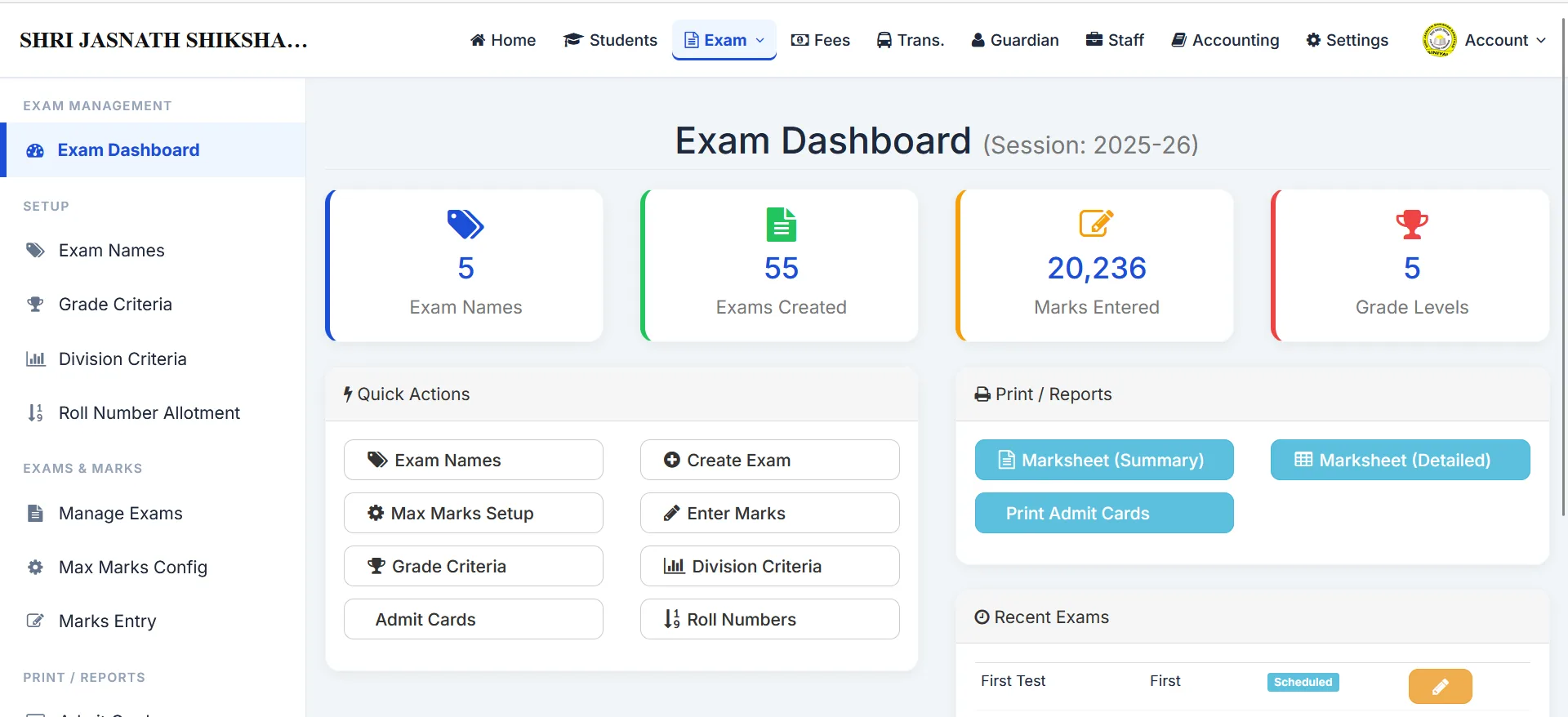
Apna School ships a real three-tier exam engine (Exam, Class Test, Unit Test), two printable marksheet formats, configurable grade table and division criteria — today. The full 360° NEP 2020 Holistic Progress Card is on the active pipeline and will be released free to every existing subscriber. Yearly ₹4,999 only.

CBSE / ICSE / RBSE / state board Two marksheet formats Auto grade & division
Apna School marksheet — three-tier exam, subject-wise marks, grade and division
Real Today

What Apna School Result & Marksheet Module Does Today

The features below are live in the product, included on every plan, ready on Day 1.

Three-Tier Exam System

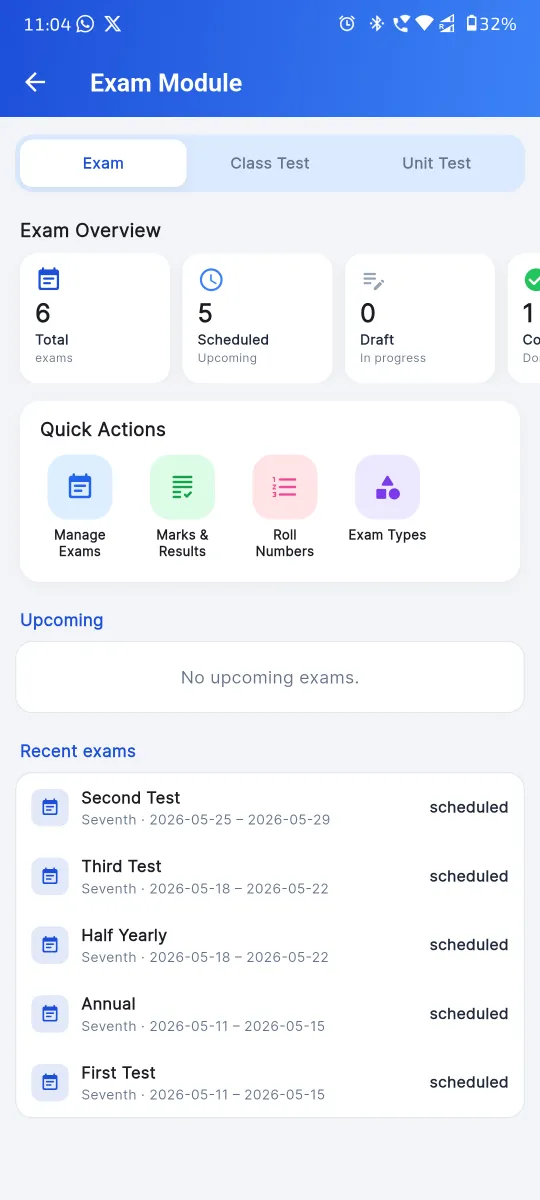
Independent modules for full Exam (Half-Yearly / Annual), Class Test (Monthly) and Unit Test (Lesson-wise). Each has its own marks entry, grade and division criteria.

Two Marksheet Formats

Two pre-built printable marksheet formats covering CBSE-style, state-board-style and Hindi-medium variants. Pick the format the school prints today.

Configurable Grade Table

Define your school’s grade band — A1 / A2 / B1 / B2…, or O / A / B / C, or any custom variant. Marksheet auto-applies the grade for each subject.

Division & Pass / Fail

Configure division criteria (First / Second / Pass / Fail) and minimum pass marks per subject. The marksheet auto-prints the result outcome.

Admit Card Generator

Print exam admit cards per class — school logo, student photo, exam centre, exam timetable.

Subject-Type Mapping

Map subjects as Compulsory / Optional / Practical. Practical subjects can have written + practical components.

Roll Number Per Exam

Assign roll numbers per exam for marks-entry sequencing — the same student can have different roll numbers across different exams.

Result on Parent App

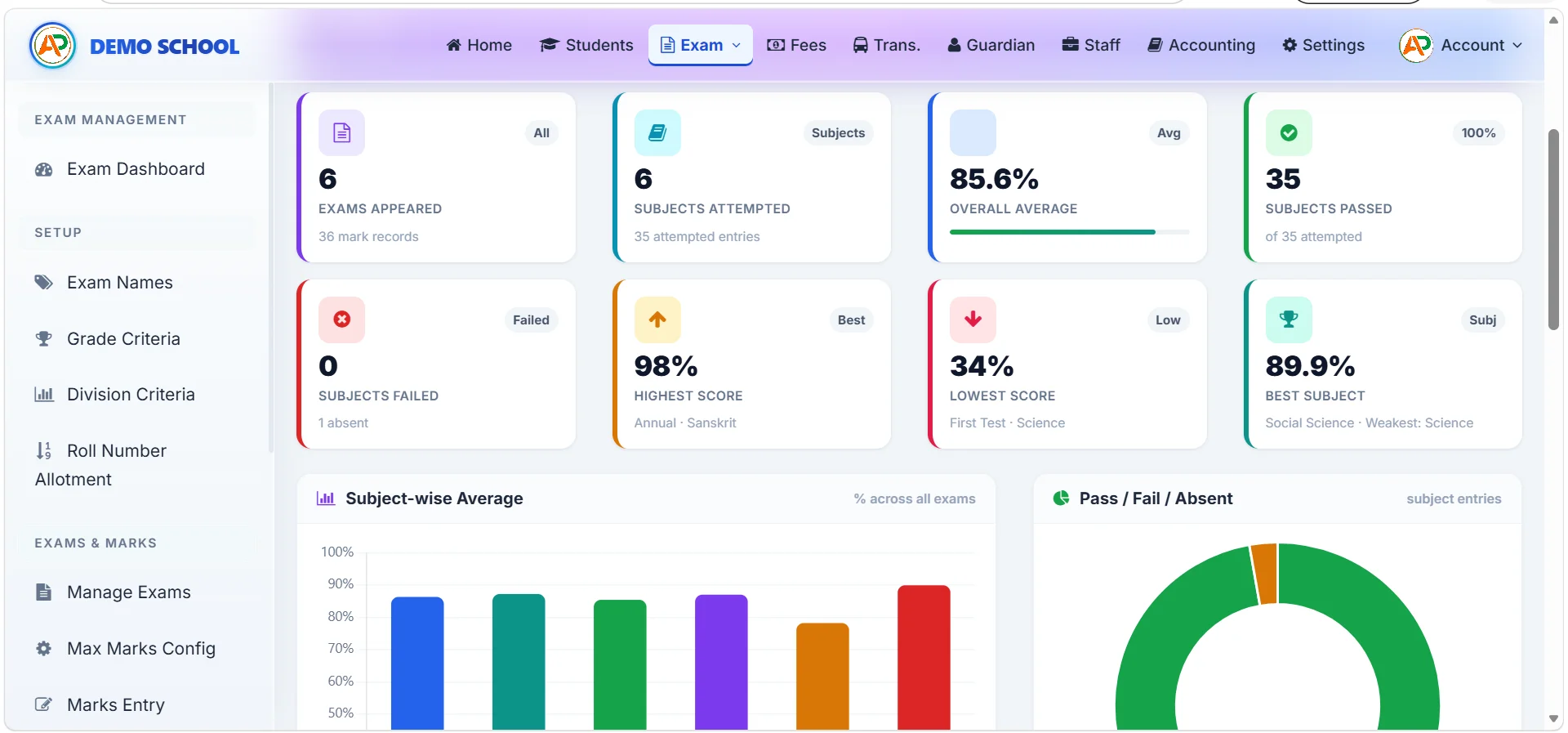
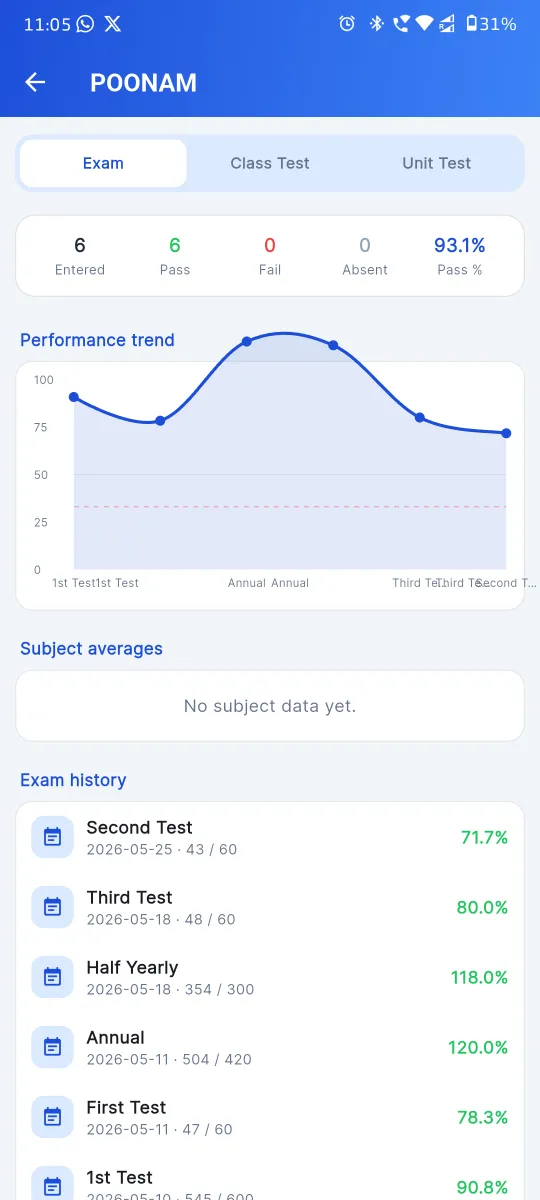
The moment marks are saved, the parent sees subject-wise marks, grade and division on the Apna School parent app — no manual upload.

IN PIPELINE · FREE FOR EXISTING SCHOOLS

360° NEP 2020 Holistic Progress Card

The full 360° Holistic Progress Card aligned to the National Education Policy 2020 framework — covering academic, co-curricular, life-skill and self-assessment domains, with peer and teacher feedback — is on the active Apna School product roadmap. CBSE and several state boards have begun phasing in the HPC format from FY 2025–26 onwards.

Our commitment: when the full HPC ships, it will be released as a free upgrade to every existing Apna School school — no new HPC module fee, no separate price tier, no “HPC add-on”. Same flat ₹4,999 / year subscription. Read the strategy in our Holistic Progress Card software guide and our NEP 2020 readiness deep-dive.

What “automatic CBSE marksheet” means in Apna School

For a CBSE-affiliated school, the marksheet flow looks like this in Apna School: the principal configures the school once (CBSE affiliation number on the school profile, two CBSE-style marksheet templates), the subject teacher saves the marks for the half-yearly exam, the system auto-applies the configured CBSE grade band (A1 95+ / A2 91–94 / B1 86–90…), the division (First ≥ 60% etc.) and the pass/fail rule per subject. The marksheet PDF prints with the school logo, the student’s photo, admission number, subject-wise marks, total, percentage, grade and division — in CBSE-conformant layout. The same flow works for ICSE, RBSE, UP Board, MP Board, Bihar Board — every grade table, division rule and marksheet format is configurable. See CBSE school management software.

Book Free Demo
CBSE marksheet generated automatically with grade and division
How It Works

Marksheet From Marks Entry — in 4 Steps

1

Configure Exam

Pick exam type (Exam / Class Test / Unit Test), set max marks, grade band and division rule.

2

Enter Marks

Subject teachers enter marks — on desktop or on the admin app from the staff room.

3

Auto Grade & Division

Grade and division apply automatically per subject and overall — no manual lookup.

4

Print & Notify

Print marksheets in two formats. Parents see results on the parent app instantly.

Pricing

Marksheet & HPC — Same ₹4,999 Subscription

APNA SCHOOL
₹4,999 / year
All modules · HPC ships free to existing schools
Start Free Demo View full plan grid ›
FAQ

Holistic Progress Card & Marksheet FAQ

The full 360° Holistic Progress Card — covering academic + co-curricular + life-skill + self-assessment + peer / teacher feedback — is on Apna School’s active product pipeline. CBSE has begun phasing in the HPC format from FY 2025–26 onwards across affiliated schools, and several state boards are following. We’re building it carefully, in consultation with school principals, so that the published HPC matches the official NEP 2020 framework rather than just rebadging the existing marksheet. What works today: a real three-tier exam system (Exam, Class Test, Unit Test), two printable marksheet formats, fully configurable grade band and division rules, subject-type mapping (Compulsory / Optional / Practical), admit card generator, and a result-visible parent app. What ships next: the official 360° HPC layout, with the multi-domain assessment, growth-tracked-across-sessions view, and parent narrative section. Free for existing schools. Read more in our HPC guide.

No. The 360° Holistic Progress Card will be released as a free upgrade to every existing Apna School subscription. No new module fee, no separate “HPC add-on”, no upgrade-tier — same flat ₹4,999 / year subscription. This is our standing commitment for everything Apna School ships into the pipeline: features that go in the ₹4,999 yearly bundle stay in the ₹4,999 yearly bundle. The only items we don’t bundle are usage-based costs (WhatsApp / SMS wallet) which the school controls anyway. So if your school subscribes today and the HPC ships in the next few months, you get it — same login, same panel, no payment, no migration.

Yes — the marksheet for a CBSE-affiliated school is fully automatic. The school configures (once) the CBSE-style grade band (A1 95+, A2 91–94, B1 86–90, B2 81–85, C1 71–80, C2 61–70, D 51–60, E 33–50, F <33), the division rule (First ≥ 60%, Second ≥ 45%, Pass ≥ 33% — or whatever the school’s policy says), the subject-wise minimum pass marks, and selects one of two pre-built marksheet templates. From then on: the subject teacher enters marks once; the system computes total, percentage, subject-wise grade, overall grade, division and pass / fail; the marksheet PDF is one click. The school logo, CBSE affiliation number, student photo and admission number are pre-printed. No Excel formula maintenance, no Word template surgery. Same automation works for ICSE, RBSE, UP Board, MP Board, Bihar Board — just the grade table differs. Deep-dive on the CBSE flow in CBSE school management software.

The three-tier exam system is Apna School’s answer to the way Indian schools actually assess: Exam (full formal exams — Half-Yearly, Annual, Pre-Board, Board — with subject-wise written marks, sometimes a practical component), Class Test (monthly tests, often per-subject, lighter than a full exam), and Unit Test (subject- and lesson-level mini tests — typical for primary classes following NCERT chapter-level assessment). Each tier is an independent module with its own configuration: max marks, grade table, division rule, marksheet template. The same student can have a Half-Yearly result, three Class Test results and twelve Unit Test results, all separate and all preserved. Most competitor school ERPs collapse this into one “Exam” module that papers over reality — the three-tier model maps directly to how Indian classrooms run.

Yes — two pre-built marksheet formats are bundled (a CBSE-style portrait layout and a state-board-style landscape layout), and either can be picked per exam. The marksheet auto-includes school logo, school name, CBSE / state-board affiliation, school UDISE code, student photo, admission number, name, class, section, exam name, subject-wise marks, total, percentage, grade, division and pass / fail outcome. For schools that need a third custom layout (a specific state-board format or a school-specific design with different language script), our team can ship a custom template as part of the onboarding bundle — included in every plan, no extra charge. The Hindi-script subject names render correctly for Hindi-medium schools. Read about Hindi-medium fit in our Hindi school software guide.

Subjects are mapped as Compulsory / Optional / Practical. For a Practical subject (typical for science subjects in CBSE / ICSE), the school configures the written component max marks and the practical component max marks separately. The marks-entry screen shows two columns; the marksheet prints both components plus the combined total; the grade applies on the combined total per the school’s grade band. For ICSE schools where some subjects have a 50:50 written:practical split (Physics, Chemistry, Biology), this is exactly how it works. For state-board schools where a vocational subject has a 30:70 split, configure those numbers per subject and the marksheet adapts. Optional subjects can be configured to be included or excluded from the overall percentage and division calculation, depending on the board’s rule.

Yes — same database, immediate visibility. The Apna School parent app and the school’s admin panel use the same cloud database (no batch upload, no overnight sync). The moment the subject teacher saves the marks-entry screen, the parent app for every linked guardian shows the subject-wise marks, computed grade, division and overall result. The full printable marksheet PDF is also one tap away on the parent app. For schools that want to hold back result visibility until the principal officially announces results (common at year-end), there is a per-exam “publish to parents” toggle — until you flip it on, the parent app shows “result pending” rather than the marks. After the principal flips it on, every parent sees their child’s result instantly. Read about the parent app’s real-time design in our school mobile app page.

Yes — multi-academic-session is built into the data model from Day 1. Each session (2024–25, 2025–26, 2026–27…) is an isolated scope, but the student record persists across sessions. So when the 360° Holistic Progress Card ships, it will already have multi-year history to draw from — the “growth-tracked-across-sessions” view that NEP 2020’s HPC framework asks for is feasible from a data-design perspective today. In the current marksheet flow, you can already pull a student’s last-session marksheet alongside the current-session marksheet for any parent meeting or board inspection. Read about Apna School’s NEP 2020 alignment in our NEP 2020 readiness guide.

From Marks Entry to Marksheet — in Minutes

Free demo — walk through the three-tier exam, two marksheet formats and the parent-app result view on a real school dataset.